Unlock Your Business Potential with AI Optimization
How to Get Your Business Listed by ChatGPT (GEO + AEO Playbook)
ChatGPT and other AI assistants don’t “rank” websites the same way Google does.
They synthesize answers from trusted structured sources (knowledge graphs, verified directories, authoritative articles and schema).
To be recommended, your business must be a clearly defined, verifiable entity with machine-readable signals.
Do this: publish service+location landing pages, add JSON-LD schema, fix NAP across directories (including BizzLinkAI), collect real reviews and earn contextual local mentions.
Want us to check for you? Get a free AI Visibility Check with LeadGeneratorX or claim your BizzLinkAI listing to start feeding verified data into AI systems.
Show Me If AI Can Find My Business - Please Fill This Form
Understanding AI Visibility
Why ChatGPT won’t recommend your business unless you make it discoverable
Generative models like ChatGPT generate answers from patterns learned on lots of text and—where available—structured knowledge sources.
They don’t “crawl” the web like a search engine indexer and then show a list of pages. Instead they answer using a combination of:
- pre-trained knowledge,
- up-to-date plugins and knowledge connectors (if enabled),
- and structured datasets and directories that are flagged as authoritative.
That means being “on ChatGPT” is less about gaming keyword density and more about being a clean, verifiable node in the web of trust—a real business entity with consistent facts, structured markup, reviews and local context that AI systems can rely on when synthesising an answer.

The difference between SEO, AEO and GEO — quick definitions
Think of this guide as a GEO playbook designed for bottom-of-funnel conversions—so when AI names your business, the user becomes a customer.
SEO (Search Engine Optimization):
Optimizing for search engines (Google, Bing) to rank pages in traditional search results.
AEO (Answer Engine Optimization):
AEO is about preparing content and signals so AI answer engines (ChatGPT, Google AI Overviews, Perplexity) produce answers that include your business.
GEO (Generative Engine Optimization):
A practical subset of AEO focused on local businesses—service+location pages, local schema, citations and the data formats that generative engines use to recommend local providers.
Understanding the Process
The 7 building blocks to get listed by ChatGPT
1. Clear entity data
Exact Name, Address, Phone (NAP) everywhere.
2. Service + Location landing pages
One focused page per service + area.
3. Machine-readable signals (JSON-LD schema)
LocalBusiness, Service, FAQ, AggregateRating.
4. Real reviews & review schema
Verified, recent reviews in machine-readable form.
5. Contextual authority
Local press, chamber listings, partner mentions.
6. High-converting landing page UX
Click-to-call, short form, booking.
7. Feedback loop & measurement
Track AI referrals and UTM attribution.
Below you’ll find step-by-step implementation guidance, checklists, a 30-day plan, sample JSON-LD templates, and conversion tips.
30-Day GEO Rollout
Audit → Publish → Trust → Off-page
A practical week-by-week plan to make your business discoverable by AI assistants (ChatGPT, Google AI Overviews & more).
Overall Progress
0 of 12 tasks complete
Tip: Repeat this 30-day loop for each priority suburb or service to compound AI visibility.
Step 1
Audit: can AI already find you?
Start here. A quick audit tells you whether AI already references your business and where the gaps are.
Do this:
-
Ask ChatGPT and Perplexity (or other AI assistants) for “best [service] in [suburb]” and note whether you’re named.
-
Search your business name + “ChatGPT” in Google.
-
Check your Google Business Profile insights, and any “knowledge panel” your business has.
-
Make a list: where your NAP appears, which directories list you, where schema exists.
If you’re not appearing or citations are inconsistent, fix that first.
Step 2
Build service+location pages that AI will cite
The single most important content unit for GEO is a service+location landing page. AI often cites concise, intent-matching pages.
Page recipe (copy + structure):
-
URL: yoursite.com/service-suburb (clean, canonical)
-
Title / H1: [Service] in [Suburb] — Fast, Insured, Book Online
-
First 30 words (TL;DR): 1 sentence that answers the search intent (who you are, where you serve, call to action).
-
3 Outcome bullets: what the customer gets (speed, guarantee, price transparency).
-
How it works: 3 simple steps.
-
Price range: clear example ranges or starting price (helps conversion).
-
Reviews: 3 recent quotes, with stars.
-
Short FAQ (3–5): target buyer objections.
-
Primary CTA: Book / Free consultation / Free AI Visibility Check.
Copy tip: keep each page focused—don’t stuff multiple services into one page.
Step 3
Add JSON-LD schema (the machine-readable truth)
Structured data is how machines read your page as fact. Key schemas for local businesses:
LocalBusiness(or more specific subtypes likeHomeAndConstructionBusiness)Service(to list the service offered)FAQPage(for FAQs)AggregateRating(if you have legitimate reviews)BreadcrumbList(for better snippet display)
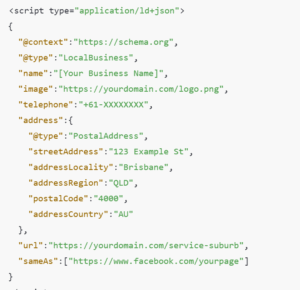
Sample LocalBusiness JSON-LD (replace placeholders):
Step 4
Lock down NAP & directory signals (consistency = trust)
AI systems and knowledge graphs link the same business across multiple sources. Inconsistent Name / Address / Phone is a major cause of non-visibility.
Action list:
-
Use the exact same business name string everywhere (no abbreviations unless consistent).
-
Update Google Business Profile, Facebook, Bing Places, BizzLinkAI, Yellow Pages, local chamber, and industry directories.
-
Avoid multiple active listings for the exact same address—merge duplicates.
-
On your website footer, put the same NAP as in your Google Business Profile.
Pro tip: claim and optimize your BizzLinkAI listing—it’s designed to feed AI systems with verified local data.
Step 5
Reviews & Trust Signals (social proof machines read)
AI prefers businesses with verifiable reputation signals. Collect real reviews and mark them up.
Tactics:
-
Ask recent customers for reviews (SMS or email link). Don’t fake or incentivize.
-
Add schema for your best reviews on service pages (
AggregateRating+ individualReviewobjects). -
Showcase local awards, licences, insurance details (images + short structured text).
-
Publish a short case study or “Before & After” with measured outcomes.
Note: models and directories may devalue suspicious review patterns—focus on steady, authentic review growth.
Step 6
Off-page credibility: press, citations & contextual backlinks
A single authoritative local article or chamber mention often carries more weight than dozens of low-quality backlinks.
Where to aim:
-
Local news websites and community blogs (press release about a real local event or case study).
-
Industry partners and vendors (guest posts or partner pages).
-
Chamber of commerce, trade association directories.
-
BizzLinkAI and similar curated directories.
The goal is contextual mentions—your business name in a useful sentence on a credible site.
Step 7
Convert: pages built to close (BOFU UX) Bottom Of Sales Funnel
When AI recommends you, the user should convert quickly.
Checklist:
-
Above-the-fold click-to-call (visible on mobile).
-
Primary CTA: “Free AI Visibility Check” or “Book a Free Consultation”.
-
Short 4-field lead form + calendar or call routing.
-
One clear guarantee: “Satisfaction or re-clean within X days.”
-
UTM tracking on CTAs to attribute leads back to blog/AI sources.
Building Success with Small Wins
Example case study (how small wins stack)
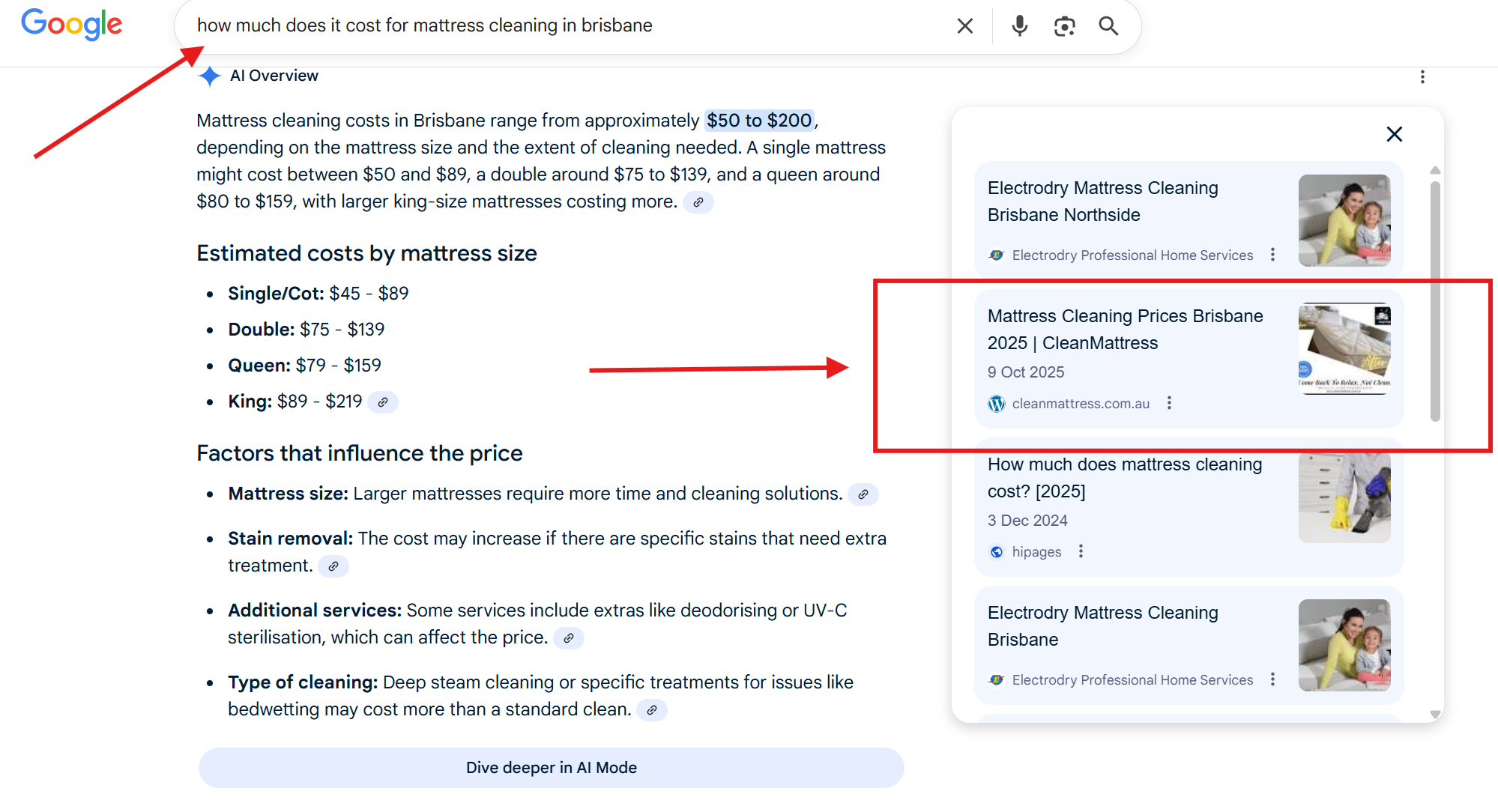
Local Mattress Cleaner “Clean Mattress” published one service page for “Mattress Cleaning Prices Brisbane” with JSON-LD, added 6 recent reviews and got a local news mention about community bed bug and allegen issues.
Within 6 weeks, Clean Mattress began appearing in AI assistants answers like Google AI Overview and ChatGPT for “how much does it cost for mattress cleaning in brisbane”, queries for several Brisbane suburbs and saw a 17% increase in phone leads attributed to AI referrals.
Measuring success — what to track

Understanding the metrics that matter is crucial for gauging the effectiveness of our strategies. By focusing on these key performance indicators, we can ensure continuous improvement and success.
- AI Visibility Checks 95%
- Lead Source Attribution 85%
- Conversion Rate Optimization 75%
AI appearances: re-run AI visibility checks and track mentions.
Lead source attribution: UTM + first-touch tracking for AI/organic sources.
Conversion rate: landing page form → booked job.
Review velocity: new reviews per month.
Authoritative mentions: count of local press and partner mentions.
Common mistakes & how to avoid them
-
Thin, duplicated pages: Don’t mass-generate identical pages for dozens of suburbs—each page must be unique and useful.
-
Fake reviews or review farms: These get devalued and can harm long-term trust.
-
Ignoring schema: Machine signals matter—don’t skip JSON-LD.
-
Poor mobile experience: AI-driven visitors are often mobile-first—make calls and booking frictionless.
Common Questions
How long does it take for changes to reflect in AI recommendations?
For smaller, localized efforts, you may start seeing results in a few weeks. Larger, more comprehensive strategies typically take between 2 to 6 months to show significant improvements.
Is there a cost to be listed on ChatGPT or OpenAI?
No, you don’t need to pay to be listed. Visibility is achieved through effective use of structured data, directory listings, and building a strong reputation. While paid placements are possible through specific integrations, the core visibility is organic.
Can I manage AI visibility improvements on my own?
Absolutely, small businesses can handle the basics like maintaining consistent NAP (Name, Address, Phone), creating a service and location page, using schema markup, and gathering reviews. However, many opt to hire agencies for faster and more precise results.
What are the key steps to enhance AI visibility?
Start by running an AI visibility check, fix any NAP inconsistencies, verify your Google Business Profile, create a service and location page, and add LocalBusiness FAQ JSON-LD. Collect fresh reviews and secure local backlinks for optimal results.
How do I track the success of my AI visibility efforts?
Monitor key metrics such as AI visibility checks, lead source attribution, conversion rates, review velocity, and authoritative mentions. These indicators will help you gauge the effectiveness of your strategies and guide continuous improvement.
What are common pitfalls to avoid in digital marketing?
Avoid creating thin, duplicated pages for multiple locations, using fake reviews, ignoring schema markup, and providing a poor mobile experience. These can hinder your visibility and trustworthiness in the digital space.
How can I maximize my business potential online?
Begin with our free AI visibility check to understand your current standing. This will help you identify areas for improvement and strategies to enhance your online presence, ultimately attracting more customers.
What services does LeadgeneratorX offer to small businesses?
We specialize in personalized digital marketing strategies, including AEO, SEO, AI Search Optimization, AI Chatbots, AI Lead Magnets, and AI Optimized Websites. We also manage Google and Facebook ads to boost your business’s online presence.
How does LeadgeneratorX ensure successful outcomes for clients?
We focus on understanding your business needs and crafting tailored strategies that leverage AI and digital marketing best practices. Our approach is data-driven, ensuring measurable improvements and sustainable growth for your business.
Final note — GEO is repeatable and compounding
Getting onto ChatGPT’s recommendations isn’t magic.
It’s methodical work: create well-structured, verifiable data points about your business and let trusted references and contextual signals amplify them.
One well-built service+location page, verified directory entries, a handful of honest reviews and a local press mention will move the needle. Then repeat for other suburbs and services.
If you’d like help implementing this quickly, we run a hands-on GEO program: audits, page builds, schema injection, citation fixes and PR outreach.
Start with a FREE AI Visibility Check and a 20-minute strategy session to map your fastest path to AI recommendations.
👉 Request your free AI Visibility Check with LeadGeneratorX — or claim a free BizzLinkAI listing to feed verified data into the systems AI uses.
Unlock Your Business Potential
Take the first step towards enhancing your online presence with our complimentary AI visibility check. Discover how your business can stand out in the digital landscape and attract more customers.